
SOLID SURFACE PARTITIONS
Design with Solid Surface
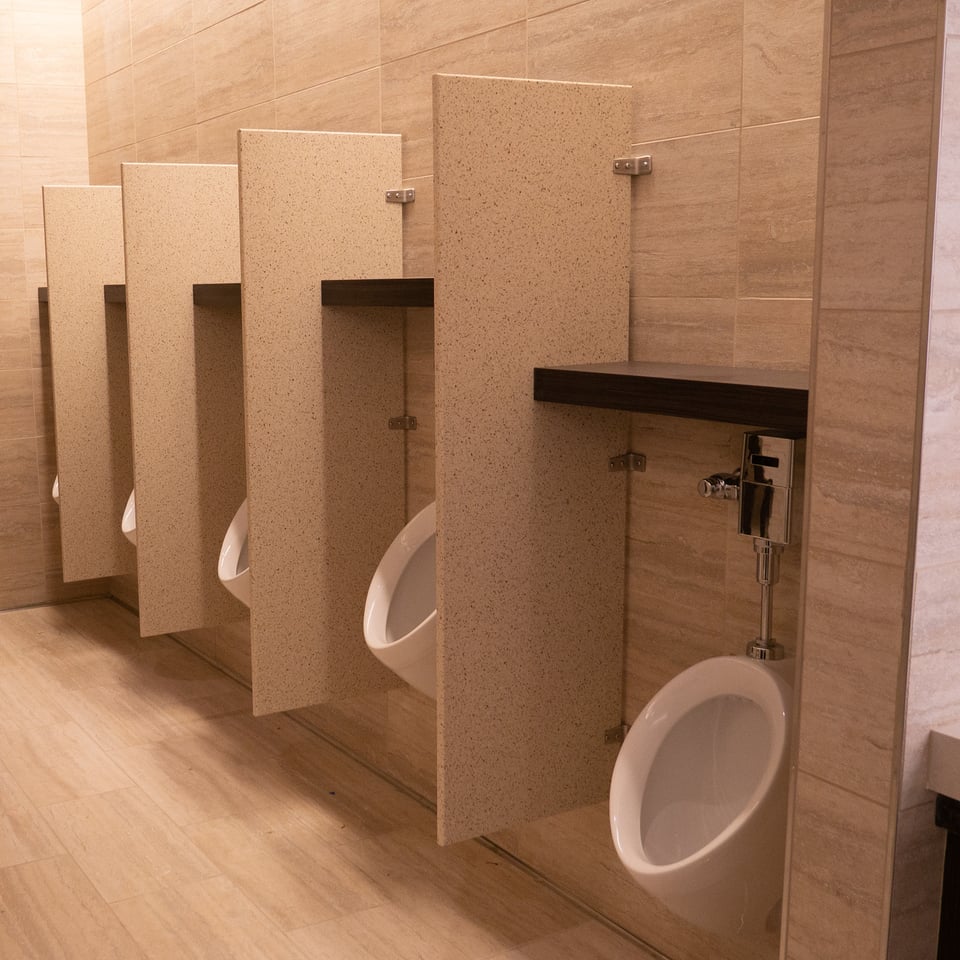
Solid Surface brings a seamless, non-porous surface that can be refinished in place to commercial restrooms where hygiene, appearance, and long service life matter.
SOLID SURFACE RESOURCES
Quick Access Hub
- View
- Open Charts
Color Charts
- View
Warranty Info
- Request
Request Samples
- Explore
Spec Builder
SOLID SURFACE VENDOR NETWORK
Is Your Pattern Available in Solid Surface?
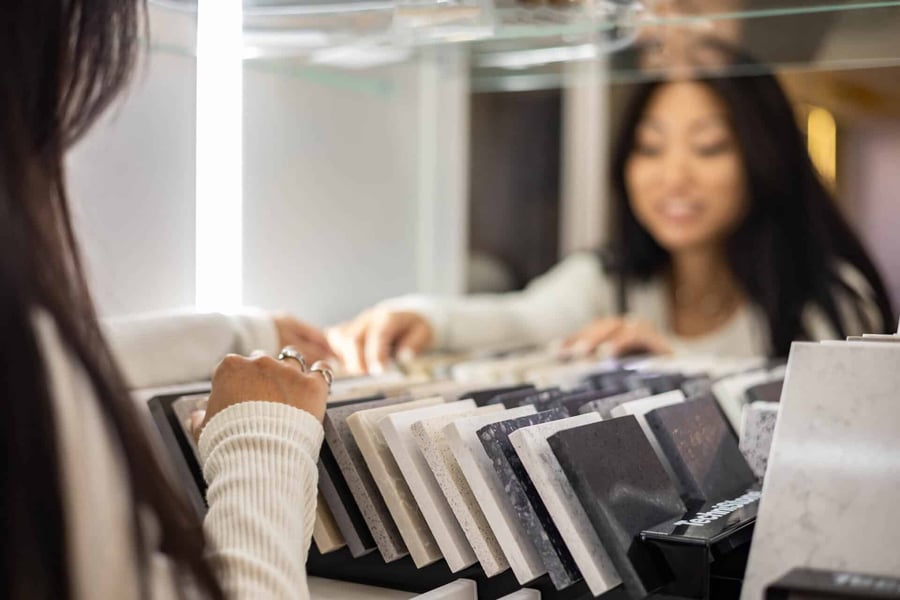
We source Solid Surface from several manufacturers. Explore their colors and patterns below. Our specialists can help confirm pattern availability, sheet width, and finish for a selection.






Have not picked a pattern yet?
Online
Browse the pattern library
Explore Solid Surface colors and patterns by manufacturer and finish.
Downloads
Color Chart
A printable reference of the matte and satin colors we recommend most often for restroom partitions.
Project Types
Common Applications
Solid Surface is often specified where a seamless, non-porous surface and a long-term finished appearance justify a higher material investment.
Healthcare
Hotels and Resorts
Casinos
Fitness and Aquatics
Offices
Cultural Centers
Golf and Country Clubs
And More
Material Selection
Why Choose Solid Surface
Solid Surface is specified for a seamless, non-porous surface that can be renewed in place, and it asks more of the budget and schedule than a laminate does. The strengths and considerations below show where it fits.
Strengths
Solid Surface components are bonded and finished so that joints typically disappear into the face, and edges are shaped in the same material rather than banded. Doors, panels, and pilasters read as one continuous surface.
Solid Surface is non-porous through its full thickness and does not absorb water. It maintains material integrity through recurring water contact in shower compartments and pool-area restrooms.
Solid Surface does not absorb stains or cleaning residue, and its flush seams leave no joint to trap soil. That suits healthcare and other programs where the partition is part of the cleanable surface plan.
Solid Surface is the one Ironwood partition material that can be sanded and refinished in place. Scratches and graffiti are removed on site, and a damaged section can typically be replaced without replacing the component.
Solid Surface is available in a broad range of solids and patterns in matte or satin finish. Because color runs through the material, engraving reads as relief in the same tone and inlays sit flush in a second color.
Solid Surface supports long replacement cycles because the marks of everyday wear are refinished rather than accumulated. Where a restroom is expected to look new for many years, that renewability can reduce maintenance and component replacement.
Considerations
Solid Surface resists everyday wear, but a hard impact may chip or crack the material rather than mark it. In restrooms with repeated impact or deliberate abuse, each incident calls for another field repair.
Solid Surface doors are slab construction, so Louver and Door Lite are not built in the material. Compact Laminate Louver and Door Lite doors pair with Solid Surface panels and pilasters, and Captured Panel is built as a custom Solid Surface construction, which adds cost and lead time to the doors.
Solid Surface doors are made at 58″ or from 71″ to 96″, and heights between 59″ and 70″ are not available. A door planned within that gap needs a different height, which is best settled during design development.
Solid Surface is a dense material, and its components are typically far heavier than laminate equivalents. Floor Mount and Ceiling Hung mounting cannot stabilize that weight, so Solid Surface partitions are mounted Headrail Braced, Floor to Ceiling, or European.
Dark Solid Surface colors show clouding, fogging, and fine scratches more readily in restroom service, and Ironwood does not warrant finish performance on them. A dark color requires written acknowledgment of these limitations before an order proceeds.
Solid Surface costs more than the laminates and Wood Veneer and less than Engineered Stone, and components are fabricated to order on a longer schedule than laminate partitions. Custom constructions and wide-format colors may add further cost and time.
Material Basics
What is Solid Surface?
Solid Surface is a homogeneous composite of acrylic or polyester resin and mineral filler, the same material through its full thickness. With no decorative layer over a core, it can be seamed, shaped, and refinished without exposing a different material beneath.
Deeper Dive
Solid Surface Insights
Composition and build-up
One material through the full thickness
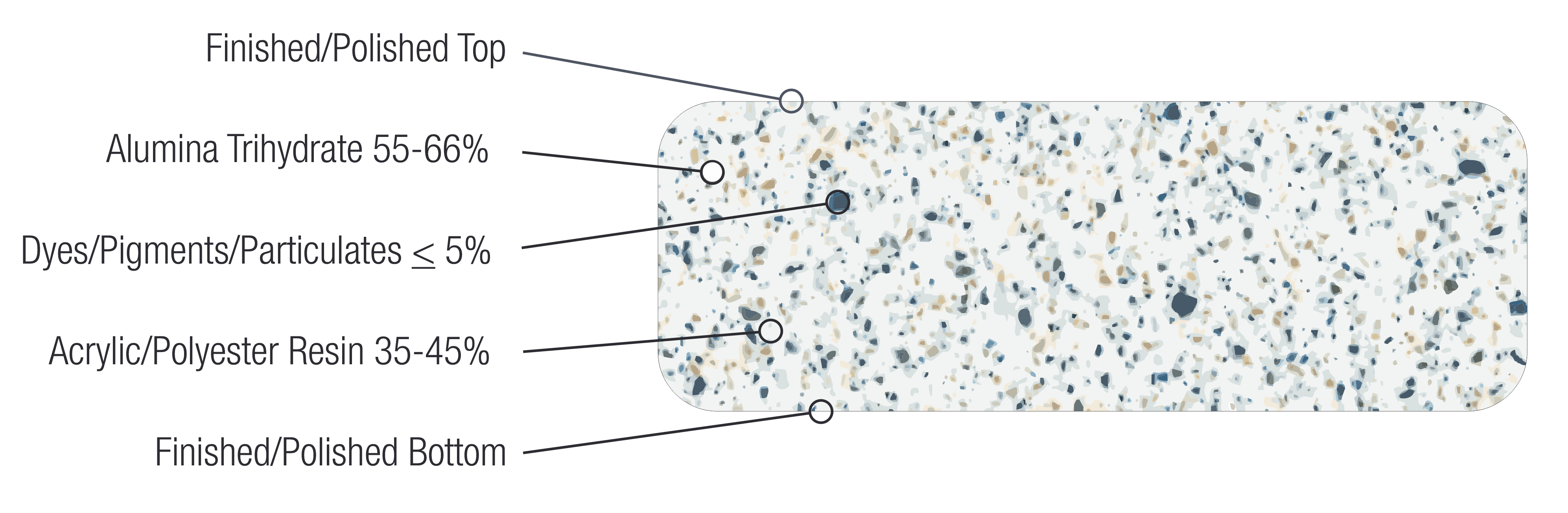
Solid Surface is cast by the manufacturer from a liquid mix of acrylic or polyester resin, alumina trihydrate mineral filler, pigments, and fire-retardant additives, then cured into a non-porous sheet that is the same material throughout. Partition components are built from two sheets bonded back to back into a 1″ component finished on both faces. Edges are shaped and finished in the same material, so there is no banding and no transition at the edge.
Veining and other laid-in details do not always extend through the sheet, so the two faces of a component may differ in a patterned color. Reviewing both faces of a sample shows how a pattern will read from inside and outside the compartment.
Composition by weight
| Component | Share |
|---|---|
| Acrylic or polyester resin | 35% to 45% |
| Alumina trihydrate filler | 55% to 66% |
| Pigments | Under 5% |
Sheet width and seam visibility
The seam follows the sheet
Solid Surface sheets are typically 30″ wide, so a component wider than that is assembled from two pieces that are butt-joined, bonded, and sanded flush. In a solid color the seam is imperceptible after finishing. In a patterned color it generally remains slightly perceptible, more so in veined and stone-look patterns, which is one reason solid colors are often selected for larger panels.
Wide-format sheets of twice the standard width are available in select colors and remove the seam from most components. Finished panel width is capped below that sheet width, so a compartment deeper than a single panel is typically divided with additional components, which affects the layout and the hardware count.
What a dense slab allows
The slab sets the styles, the weight sets the mounting
Solid Surface doors are slabs of the same material as the panels and pilasters, the construction behind Flat Panel, Engraving, Applied Molding, and Inlay. Captured Panel is built around a Solid Surface insert. Louver and Door Lite depend on stile-and-rail construction, which is not fabricated in this material, so those doors are built in Compact Laminate and paired with the Solid Surface partition.
Doors are made in two height ranges, with no doors between 59″ and 70″. Doors in the taller range need a headrail or transom above them, and the tech data sheet lists the hardware for each height. The material's weight also rules out Floor Mount and Ceiling Hung, because a pilaster anchored only at the floor or only at the ceiling cannot be stabilized under Solid Surface.
Door heights
| Height | Availability |
|---|---|
| 58″ | Available |
| 59″ to 70″ | Not available |
| 71″ to 96″ | Available |
Cleaning, wear, and repair
Repair happens in place
Solid Surface resists the wear of daily cleaning, and routine care is mild soap and water or a non-abrasive cleaner. Because the material is the same through its thickness, sanding removes surface damage without exposing a different layer beneath. Shallow damage is refinished and blended into the surrounding face, and deeper damage is cut out and replaced with a section bonded flush, so a damaged component rarely has to leave the building.
The limit is impact. A hard blow may chip or crack the resin body, and field repair makes that damage recoverable. Where partitions take repeated impact, the frequency of repair becomes part of the ownership cost.
Finish selection and color behavior
Finish and color decide how marks show
Solid Surface is finished by sanding rather than coated, so the finish is a property of the surface itself. Matte is the default because it conceals minor scratches and reads evenly under restroom lighting. Satin generally shows scratches and scuffs more readily, and a polished finish shows them rapidly and is not recommended for restroom partitions. Paint and stain finishes are not compatible with the material.
Dark colors show clouding, fogging, and fine scratch patterns more readily than lighter tones, and Ironwood does not warrant finish performance on them. A dark color can be specified with written acknowledgment of those limitations, and matte mid-tones are the usual selection where long-term appearance is the priority. Copper-infused antimicrobial Solid Surface is available from select manufacturers for projects with enhanced hygiene requirements.
Renewal instead of replacement
Longevity is the environmental case
The environmental case for Solid Surface rests on service life. A partition that can be refinished in place stays in service through wear that would otherwise call for replacement components, and fewer replacements mean less material consumed and discarded over the life of the restroom.
The material itself is a resin composite with a majority mineral filler. Recycled content, low-emission certifications, and environmental declarations vary by manufacturer and product, so the documentation a project requires is confirmed for the specific color at submittal rather than assumed for the material.
The Process
How to Specify Ironwood
A complete Ironwood specification in three steps.
Open the Spec Builder
A few guided choices turn your design intent into an exact Ironwood model number.
Download Your Spec Package
A CSI spec, cut sheet, and technical data are generated instantly for your exact model.
Send It or Ask Us Anything
Call 360-568-1823 or email specs@ironwood-mfg.com. Our specialists walk projects end-to-end.
What You Walk Away With
- CSI Spec
- Cut Sheet
- Technical Data
Common questions about Solid Surface

Cannot find the answer you are looking for? Our specialists are happy to walk projects end-to-end.
Contact Us- Solid Surface should be considered when the design calls for a seamless surface with edges finished in the same material, or when wear is expected to be refinished in place over a long service life. Compact Laminate generally provides a lower material cost, better tolerance of impact and abuse, and a wider range of door styles under the same moisture conditions.
- Both are non-porous materials at the top of Ironwood's price range. Engineered Stone reads as polished quartz with mineral depth, is the heavier and higher-cost of the two, and is supplied as panels and pilasters only, with doors in another material. Solid Surface reads as a uniform matte or satin surface, supports slab doors in the same material, and can be refinished in place, which stone cannot.
- Yes. Solid Surface is non-porous through its full thickness, and its seams are bonded and finished flush, which suits shower compartments, dressing compartments, and pool-area restrooms. Floor to Ceiling is generally the preferred mounting style in wet areas, paired with corrosion-resistant hardware.
- Solid Surface partitions can remain in service for decades because surface damage can be sanded out and refinished in place, and Ironwood backs the material with a 20-year limited warranty. Service life depends on cleaning practices, the level of impact and abuse the facility experiences, and the color selected, since dark colors show wear sooner and are excluded from the finish warranty.
- Yes, with conditions. Dark Solid Surface colors show clouding, fogging, and fine scratches more readily in restroom service, and Ironwood does not warrant finish performance on them. A dark color requires written acknowledgment of those limitations before an order proceeds, and the tech data sheet states the conditions. Matte mid-tones are generally selected where long-term appearance is the priority.
Solid Surface partitions are cleaned with mild soap and water or a non-abrasive household cleaner. Because the material is non-porous, stains and cleaning residue stay on the surface, where routine cleaning removes them.
Yes. A trained technician repairs minor scratches, scuffs, and graffiti on Solid Surface partitions on site, with a refinish pass that blends the repair into the face. Deeper gouges or cracks are cut out and a new section is bonded and finished flush by a certified fabricator. We recommend contacting Ironwood before any field repair.
- Flat Panel, Engraving, Applied Molding, and Inlay are available as Solid Surface slab doors, and Captured Panel is available as a custom construction. Louver and Door Lite depend on stile-and-rail construction, which is not fabricated in this material. Projects that want those styles pair Solid Surface panels and pilasters with Compact Laminate Louver or Door Lite doors, which also suit wet areas, or with Wood Veneer doors in dry interiors, which offer every Ironwood door style.
- Solid Surface doors are available at 58″ and from 71″ to 96″, and heights between 59″ and 70″ are not available. Doors 71″ and taller need a headrail or transom above the door. The Solid Surface tech data sheet lists the hardware for each height, and settling the height early keeps hardware and mounting aligned.
In a solid color the seams are imperceptible after sanding and finishing. In a patterned color a seam generally remains slightly perceptible, and veined or stone-look patterns show it more than uniform tones. Wide-format sheets are available in select colors and remove the seam from most components, so a solid color or a wide-format pattern is often chosen where seam visibility matters.
Gallery
Featured Solid Surface Bathroom Stalls
Explore door styles, seams, and mounting configurations in completed Solid Surface projects.
Inlay · Headrail Braced
Flat Panel · Headrail Braced
Flat Panel · Headrail Braced
Explore Others
Looking for a different option?
Every partition material involves trade-offs. Compare moisture exposure, traffic levels, finish requirements, and budget considerations to determine the best fit for your project.
High Pressure Laminate HPL
High Pressure Laminate (HPL) pairs a decorative laminate surface with a wood core and offers the widest selection of colors and patterns.
Compact Laminate CPL
Compact Laminate combines a decorative surface with solid phenolic construction for wet areas and demanding use.
Wood Veneer
Wood Veneer brings the grain, figure, and stain-matched finish of real hardwood to restroom partitions in interior, climate-controlled spaces.
Engineered Stone
Engineered Stone, often referred to as quartz, is a polished, non-porous material for panels and pilasters, typically paired with doors in another material.