
ENGINEERED STONE PARTITIONS
Design with Engineered Stone
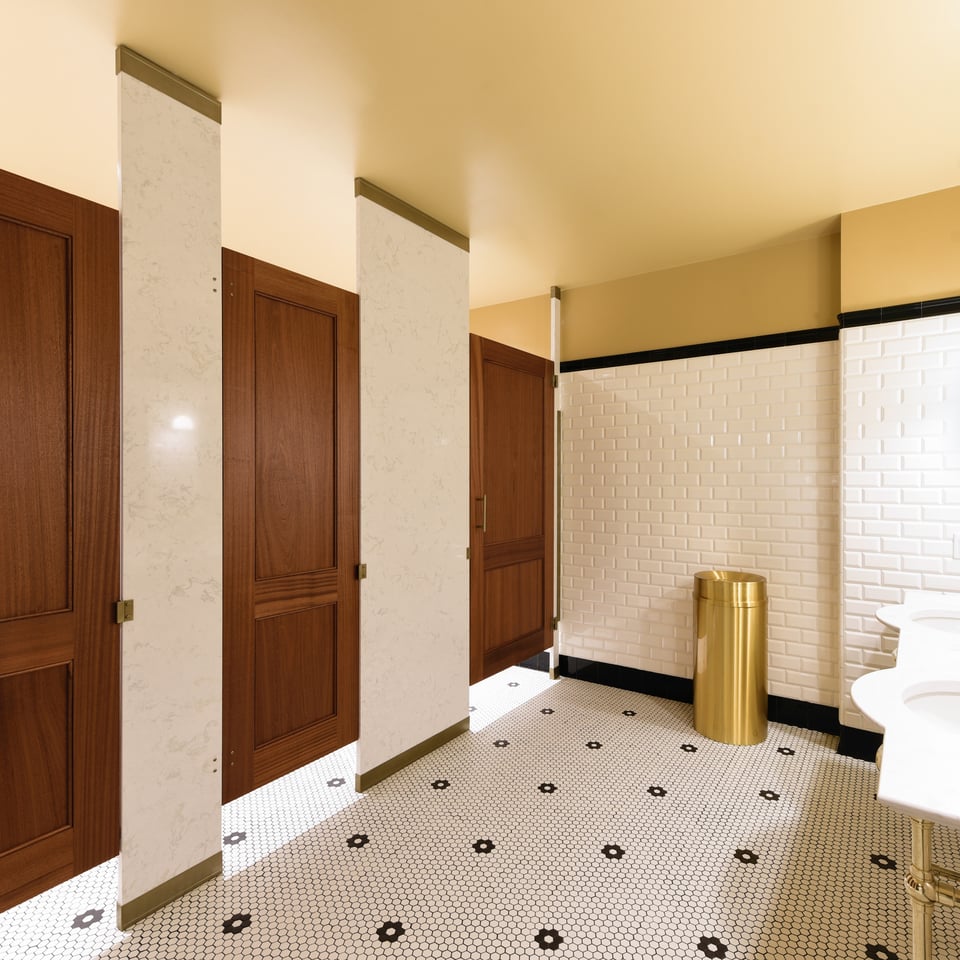
Engineered Stone, often referred to as quartz, brings the mineral depth and visual weight of polished stone to restroom panels and pilasters, in a non-porous surface suited to wet areas.
ENGINEERED STONE RESOURCES
Quick Access Hub
- View
- Open Charts
Color Charts
- View
Warranty Info
- Request
Request Samples
- Explore
Spec Builder
ENGINEERED STONE VENDOR NETWORK
Is Your Pattern Available in Engineered Stone?
We source Engineered Stone from several quartz manufacturers, whose color ranges are narrower than the laminate libraries. Explore their colors and patterns below. Our specialists can help confirm availability and slab size for a selected pattern.







Have not picked a pattern yet?
Project Types
Common Applications
Engineered Stone is commonly specified for restrooms where polished stone and a substantial material presence suit the character of the project.
Hotels and Resorts
Offices
Museums and Visitor Centers
Performing Arts Venues
Golf and Country Clubs
Fitness and Spas
Casinos
Retail
Material Selection
Why Choose Engineered Stone
Engineered Stone brings the presence of polished stone to the restroom and asks more of the building than lighter materials. The strengths and considerations below show where it fits.
Strengths
Engineered Stone brings the mineral depth and veining of stone to restroom partitions. Its polished, high-gloss face enhances color depth and pattern visibility across every panel and pilaster.
Engineered Stone panels and pilasters carry the visual mass of solid stone. Doors in another material can contrast with that mass, giving the partitions a layered, architectural character.
Engineered Stone's non-porous quartz surface tolerates recurring water contact in shower compartments and pool-area restrooms. Paired with doors in a wet-area material, it carries a polished stone finish into showers and locker rooms.
Engineered Stone's quartz content makes it resistant to scratching and impact as a material, which helps panels and pilasters withstand the everyday wear of busy restrooms.
Engineered Stone brings a stone appearance to partitions where natural stone is not typically used. Some granite and marble products are too porous or brittle for partition components, while the resin-bound quartz slab is non-porous.
Considerations
Engineered Stone doors are reviewed project by project and need heavy-duty hardware. Most stone partitions use doors in another material, and that material determines the available door styles and hardware.
Engineered Stone is the heaviest material Ironwood offers, and structural support at the mounting points must be verified before it is specified. The weight also rules out Floor Mount and Ceiling Hung mounting.
Engineered Stone slab sizes vary by manufacturer and color. Components larger than the slab require a seam, which adds cost, and larger layouts may be divided by additional components such as a back-wall pilaster.
Engineered Stone color and veining may vary between components and from samples. Veining on one face may not carry through to the other, so a partition can read differently from inside and outside the compartment.
Engineered Stone is the highest-cost material Ironwood offers. Slab availability, shipping, specialized installation, and additional engineering review can each extend both the budget and the schedule.
Material Basics
What is Engineered Stone?
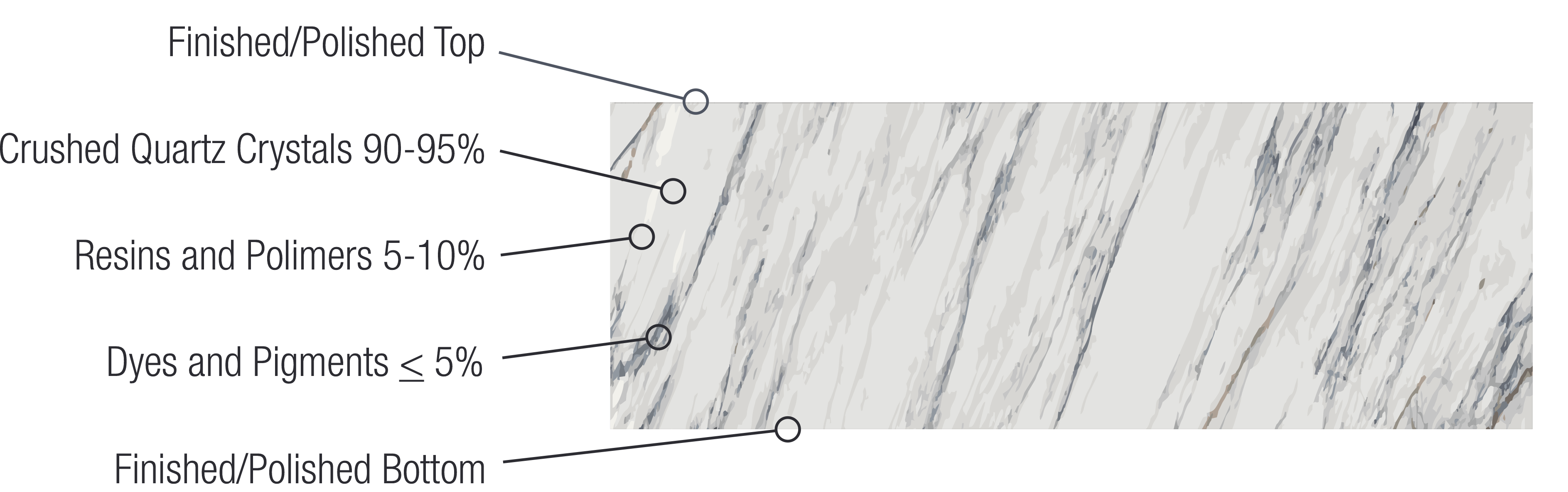
Engineered Stone is a dense slab of ground natural quartz bound with polymer resin and pigment. The quartz gives the surface its mineral depth and hardness, while the resin closes it into a non-porous material.
Deeper Dive
Engineered Stone Insights
Composition and fabrication
The slab is the finished component
Engineered Stone is formed by blending ground natural quartz with polymer resins and pigments, then pressing the mixture into slabs under high pressure and heat. Partition components are cut from the slab itself, with no core or applied face. Both faces are polished, which brings the raw slab to its finished thickness, and every exposed edge is polished to match.
A specialist stone fabricator cuts each component on CNC equipment. Stone components cannot be adjusted in the field, so their dimensions are settled before fabrication begins.
Structure, mounting, and installation
Weight extends beyond the partition
Engineered Stone's density varies by manufacturer and pattern, and the example weights below show the load a single panel or pilaster carries. That load reaches the building at every mounting point, which is why the supporting structure is confirmed before the material is specified.
The same weight determines how the partitions are mounted and installed. Headrail Braced and Floor to Ceiling mounting support Engineered Stone. Floor Mount and Ceiling Hung cannot carry it, and European is unavailable because stone does not take pedestals. Components are mounted with stainless steel hardware. Shipping costs more than for other materials, and installation calls for specialized installers, equipment, and additional time.
Surface wear, cleaning, and repair
A hard surface can still show wear
Engineered Stone resists scratching and impact as a material, and its non-porous surface does not absorb stains. The polish is the more vulnerable part: acidic cleaners etch and dull it, so routine care stays with mild soap and water or a stone-specific cleaner, and stains are typically lifted with a non-abrasive stone cleaner.
The high-gloss finish that enhances color depth also makes wear easier to see. In high-abuse environments, the polished surface can show wear even though the material resists damage. Engineered Stone cannot be sanded and refinished in the field the way Solid Surface can, so wear on the polished face is not removed in place.
Slab dimensions and seams
Slab size follows the color
Engineered Stone slab dimensions vary by manufacturer and color, so the selected pattern sets the largest component that can be cut without a seam. Typical slab widths place wide panels and deep compartments near that limit.
A component larger than the slab can be seamed by the stone fabricator, which adds cost. A back-wall pilaster can divide the run instead, keeping each panel within a single slab. Confirming slab size for the selected color before component dimensions are finalized keeps both options open.
Door materials and edge details
Two materials meet at the pilaster
Engineered Stone is supplied as panels, pilasters, transoms, and urinal screens. Stone doors are by review, so most doors are built in another material. The door material, not the stone, determines which door styles and hinges are available, and in shower compartments and other wet areas it is chosen for the same water contact the stone panels see.
Stone pilasters can still receive the Zero Sightline edge profile. Other materials share one thickness between door and pilaster, while on a stone job the rabbets are cut for the actual thicknesses of the stone pilaster and the alternate-material door. Transoms match the pilaster thickness and urinal screens match the panel thickness, keeping the stone consistent across the components it supplies.
The Process
How to Specify Ironwood
A complete Ironwood specification in three steps.
Open the Spec Builder
A few guided choices turn your design intent into an exact Ironwood model number.
Download Your Spec Package
A CSI spec, cut sheet, and technical data are generated instantly for your exact model.
Send It or Ask Us Anything
Call 360-568-1823 or email specs@ironwood-mfg.com. Our specialists walk projects end-to-end.
What You Walk Away With
- CSI Spec
- Cut Sheet
- Technical Data
Common questions about Engineered Stone

Cannot find the answer you are looking for? Our specialists are happy to walk projects end-to-end.
Contact Us- Engineered Stone is worth considering when the design calls for polished quartz with the mineral depth and visual weight of stone. Solid Surface is lighter, costs less, supports doors in the same material, and can be refinished in place. Both are non-porous and suited to wet areas, and both sit at the top of Ironwood's price range.
- Only by review. Engineered Stone is supplied as panels, pilasters, transoms, and urinal screens. A stone door is reviewed project by project and needs heavy-duty hardware, so most stone partitions use doors in another material. Wood Veneer is typical and High Pressure Laminate is also used, and both offer every Ironwood door style. In shower compartments and other wet areas, doors are specified in Compact Laminate or Solid Surface, which tolerate recurring water contact.
- Yes. Engineered Stone panels and pilasters are non-porous and suited to shower compartments, pool areas, and humid locker rooms. Shower doors on stone partitions are typically built in a material suited to the same exposure, Compact Laminate or Solid Surface. Floor to Ceiling mounting is preferred in shower compartments.
Not typically. Some natural stone products are too porous or brittle for partition components. A natural stone selection may be possible with the material supplier's approval and additional engineering, which typically calls for thicker, doubled pilasters, so we recommend raising the request early in the design process.
- Engineered Stone partitions can remain in service for many years and are backed by Ironwood's 10-year limited warranty, which covers the stone components; doors carry the warranty of their own material. Service life depends on traffic, cleaning practices, and the level of abuse, since the polished finish can show wear in high-abuse environments.
Engineered Stone partitions can be cleaned with mild soap and water or a stone-specific cleaner, and stains are typically removed with a non-abrasive stone cleaner. Acidic cleaners should not be used because they can etch and dull the polished surface.
Engineered Stone weighs roughly 143 pounds per cubic foot, and density varies by manufacturer and pattern. A 58″ × 58″ panel weighs about 207 pounds. That weight limits mounting to Headrail Braced and Floor to Ceiling and calls for verified structural support at each mounting point.
Engineered Stone panels reach up to 96″ tall and pilasters up to 120″. Slabs are typically about 55″ to 65″ wide and 120″ to 130″ long, depending on the manufacturer and color. A component larger than the slab requires a seam, which adds cost, so slab size is best confirmed for the selected color before component dimensions are finalized.
Gallery
Featured Engineered Stone Bathroom Stalls
Explore door materials, door styles, and mounting configurations in completed Engineered Stone projects.
Captured Panel · Floor to Ceiling
Door Lite · Headrail Braced
Engraving · Headrail Braced
Captured Panel · Floor to Ceiling
Explore Others
Looking for a different option?
Every partition material involves trade-offs. Compare moisture exposure, traffic levels, finish requirements, and budget considerations to determine the best fit for your project.
High Pressure Laminate HPL
High Pressure Laminate (HPL) pairs a decorative laminate surface with a wood core and offers the widest selection of colors and patterns.
Compact Laminate CPL
Compact Laminate combines a decorative surface with solid phenolic construction for wet areas and demanding use.
Wood Veneer
Wood Veneer brings the grain, figure, and stain-matched finish of real hardwood to restroom partitions in interior, climate-controlled spaces.
Solid Surface
Solid Surface brings a non-porous surface that can be refinished in place to commercial restrooms where hygiene and long-term appearance matter.