
COMPACT LAMINATE PARTITIONS
Design with Compact Laminate
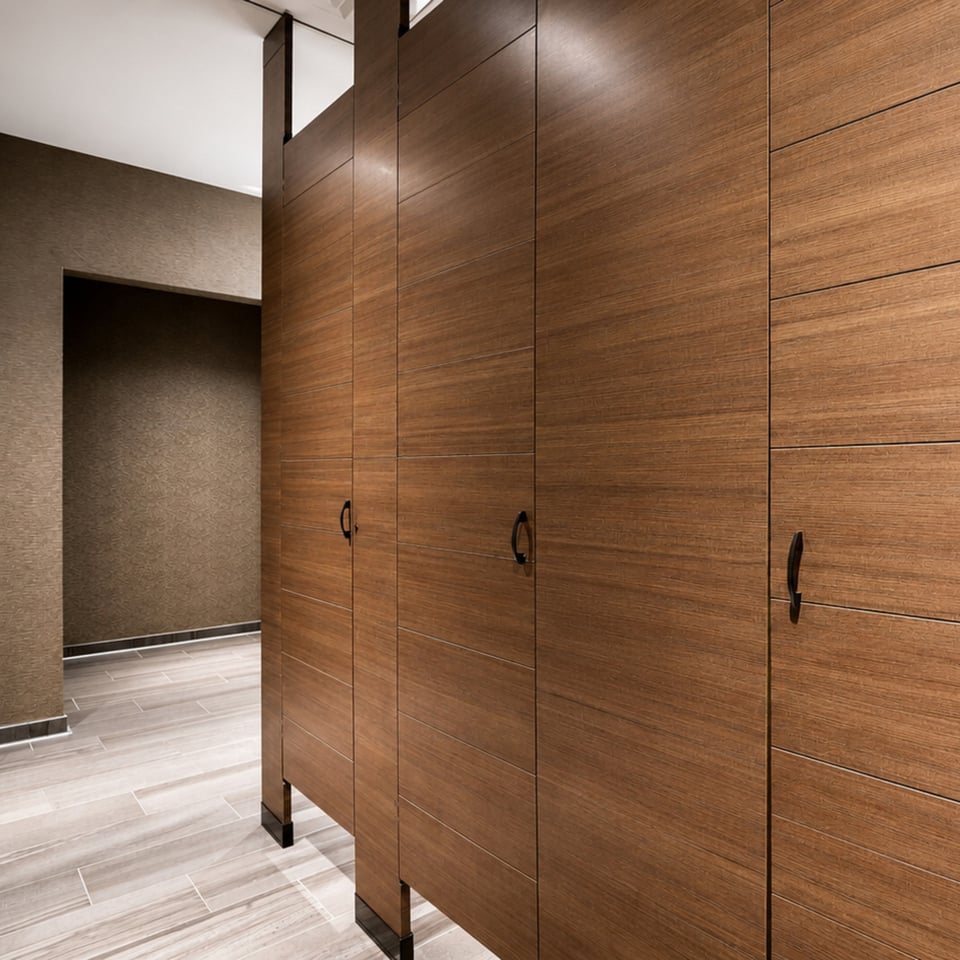
Compact Laminate brings decorative finishes and solid phenolic construction to commercial restrooms where value, moisture resistance, and durability matter.
COMPACT LAMINATE RESOURCES
Quick Access Hub
- View
- Open Charts
Color Charts
- View
Warranty Info
- Request
Request Samples
- Explore
Spec Builder
COMPACT LAMINATE VENDOR NETWORK
Is Your Pattern Available in Compact Laminate?
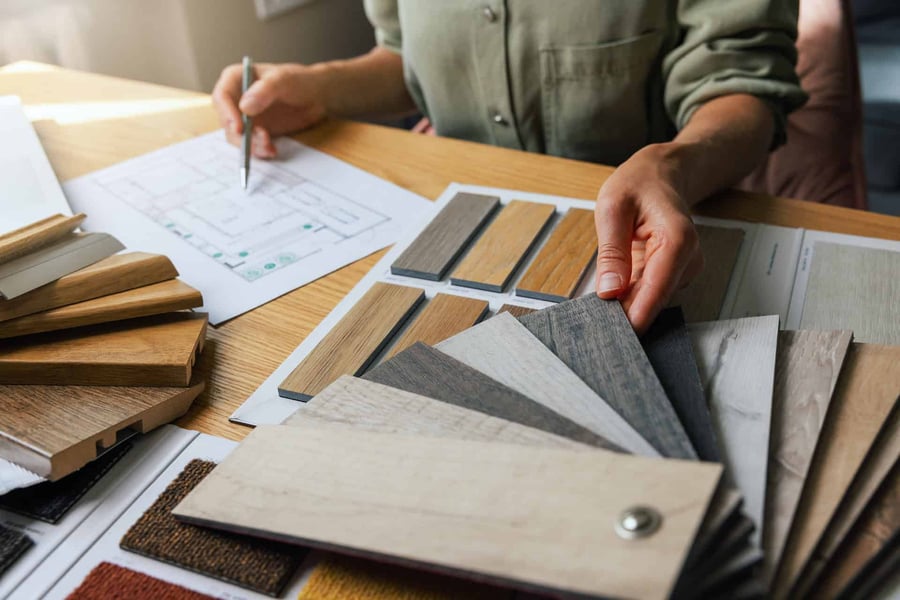
We source Compact Laminate from several manufacturers. Explore their colors and patterns below. Our specialists can help confirm pattern availability and find additional options.








Have not picked a pattern yet?
Online
Browse the pattern library
Explore Compact Laminate colors, woodgrains, and patterns by manufacturer and finish.
Project Types
Common Applications
Compact Laminate brings a wide choice of colors, patterns, and woodgrains to commercial interiors where both appearance and performance matter.
Fitness and Aquatics
Schools and Universities
Stadiums and Arenas
Golf and Country Clubs
Casinos
Hotels and Resorts
Theme Parks
Performing Arts
Material Selection
Why Choose Compact Laminate
Compact Laminate combines resistance to demanding service conditions with decorative finishes. The strengths and considerations below show where it fits and what to account for in a partition design.
Strengths
Compact Laminate is well suited to environments where moisture exposure is expected. Its homogeneous construction maintains material integrity through recurring water contact in shower compartments and pool-area restrooms.
Compact Laminate is suited to restrooms where high traffic and physical abuse influence material selection. It resists impact and withstands the wear associated with repeated use.
Maintenance and replacement requirements influence long-term ownership value. Compact Laminate offers extended service life, reducing maintenance demands and the need for future material replacement.
Compact Laminate offers design flexibility alongside the durability and moisture resistance of its solid phenolic construction. Compact Laminate is available in a broad range of solids, patterns, and woodgrains and can incorporate custom graphics, engraving, and inlays.
Ironwood's standard HeH banding conceals the black core at exposed Compact Laminate edges. It coordinates the edge color with the decorative face for a more continuous appearance across doors and panels.
Compact Laminate builds on a well-established family of materials used throughout commercial interiors. It carries that familiar approach to finish selection and design coordination into restroom partitions.
Considerations
Compact Laminate performs well in wet areas, but warranty coverage varies by manufacturer. Inlays, inserts, applied moldings, and other adhered features introduce glue lines that may create failure points under sustained moisture exposure.
Compact Laminate components are limited by available sheet sizes and cannot be enlarged through splicing. Larger layouts may require additional components and hardware, which can influence partition appearance and configuration.
Compact Laminate is available in a wide range of patterns, but finish options are more limited. Pattern and finish selections should be confirmed early, as not all combinations are available.
Compact Laminate performs best when environmental conditions remain reasonably consistent on both sides of a component. Significant differences in temperature or airflow between surfaces may contribute to warping.
Material Basics
What is Compact Laminate?
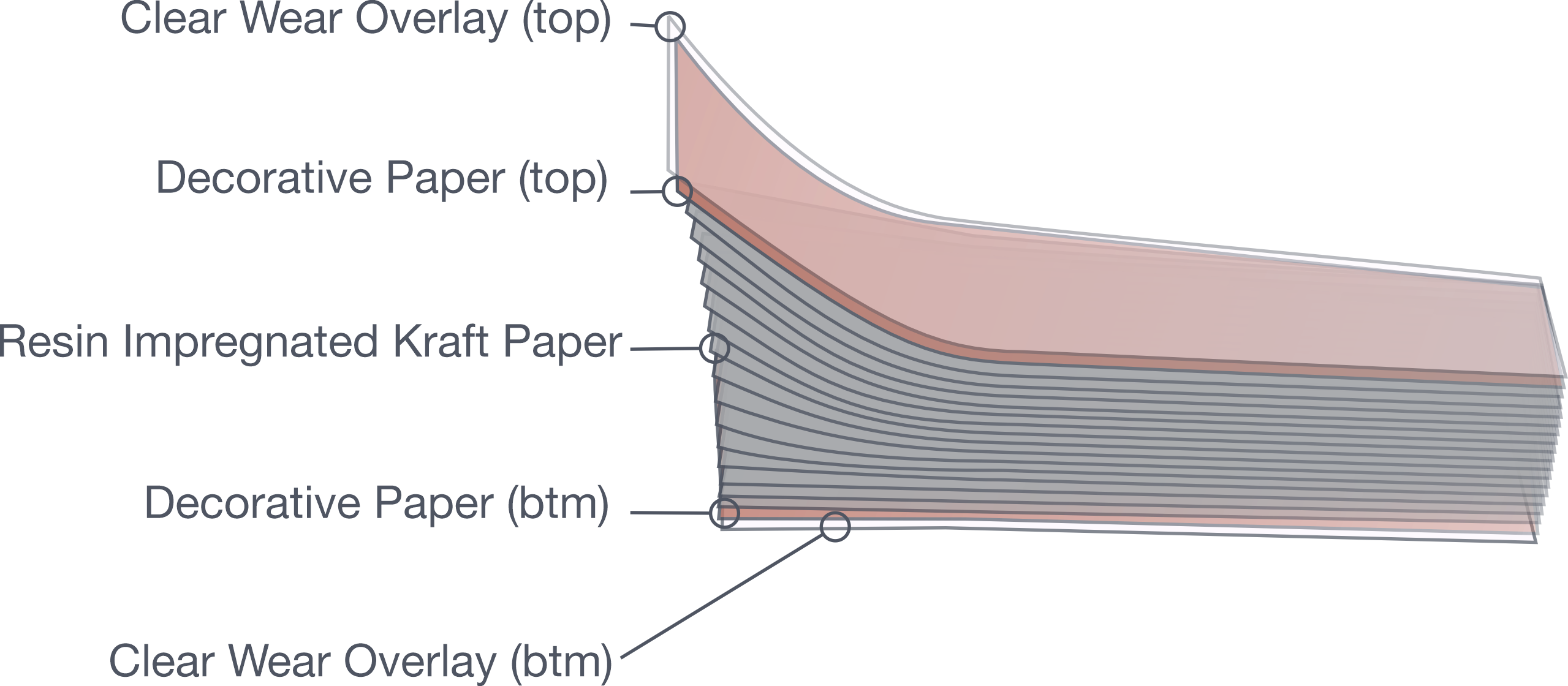
Compact Laminate is a homogeneous material that provides strength and moisture resistance. The decorative surfaces bring color, pattern, and texture, contributing to the material's visual character.
Deeper Dive
Compact Laminate Insights
Papers, resins, and pressure
Many layers, one material
Compact Laminate is a homogeneous panel formed by pressing resin-impregnated kraft papers, decorative surface papers, and protective wear overlays into a single assembly. Heat and pressure fuse these layers into a finished panel. Once pressed, the assembly behaves as a single material rather than a stack of separate layers. This construction influences how the material responds to environmental conditions, wear, and long-term use.
Density and component response
Density changes the equation
Compact Laminate is a high-density material. Its density and homogeneous construction contribute to substantial weight, strong screw holding, and high flexural strength. These properties help doors and panels resist substantial impacts; hard strikes may leave visible surface damage without making a component unusable. Together, these properties shape how partitions perform in ordinary commercial restrooms, with strength and impact resistance especially valuable where traffic or physical abuse is greater.
Exposure, movement, and flatness
Movement starts with imbalance
Compact Laminate responds to changes in temperature and environmental conditions. When both faces of a panel experience similar conditions, the risk of warping is reduced. Differences between the conditions on either face, whether caused by direct sunlight, HVAC airflow, or other exposure, can contribute to movement, bowing, and changes in flatness. On a door, a change in flatness can affect latch alignment and the fit of Zero Sightline details. Such effects help explain why acclimation, dimensional stability, and allowable warpage matter in toilet partition applications.
Cleaning, wear, and repair limits
Durability is not repairability
Compact Laminate's closed, non-porous surface supports frequent cleaning and resists a broad range of commercial cleaners and disinfectants used in restrooms. Ink and graffiti marks are often removable with appropriate cleaning. Deep scratches and gouges can remain visible after cleaning because they alter the surface itself. Once damage extends beyond the decorative surface, repair options become limited, and restoring the original appearance may require replacement of the damaged component.
Sheet sizes and pattern direction
Small changes, disproportionate effects
Compact Laminate components must be cut from available sheet sizes. A small increase in door or pilaster dimensions can reduce yield or require an additional sheet. Directional patterns further limit how components can be arranged for cutting. Together, these constraints make material yield and project cost sensitive to small changes in component dimensions or pattern direction.
Common domestic sheet sizes
| Width | Length |
|---|---|
| 48″ | 96″ · 120″ |
| 60″ | 96″ · 120″ · 144″ |
Element Series component heights
| Component | Standard heights |
|---|---|
| Doors | 58″ · 72″ · 84″ |
| Panels | 58″ · 72″ · 84″ |
Sourcing, service life, and replacement
What lasts matters
Compact Laminate is a self-supporting panel made from resin-impregnated kraft papers typically sourced from responsibly managed forests. Environmental declarations and certifications vary by product. Available supplier documentation can be provided for project review and may address material content, sourcing, emissions, and environmental impacts. Early review of these documents helps align material selection with project-specific environmental requirements.
Beyond sourcing, Compact Laminate's resistance to recurring moisture and wear can support a long service life in demanding restrooms. When partitions remain in service longer, fewer replacement components are needed, reducing the material use and waste associated with replacement.
The Process
How to Specify Ironwood
A complete Ironwood specification in three steps.
Open the Spec Builder
A few guided choices turn your design intent into an exact Ironwood model number.
Download Your Spec Package
A CSI spec, cut sheet, and technical data are generated instantly for your exact model.
Send It or Ask Us Anything
Call 360-568-1823 or email specs@ironwood-mfg.com. Our specialists walk projects end-to-end.
What You Walk Away With
- CSI Spec
- Cut Sheet
- Technical Data
Common questions about Compact Laminate

Cannot find the answer you are looking for? Our specialists are happy to walk projects end-to-end.
Contact Us- Compact Laminate should be considered when sustained moisture or repeated impact is expected. Its dense construction also suits high-use and abuse-prone environments. For otherwise comparable partition designs, High Pressure Laminate generally provides a lower initial cost when those performance demands are absent.
Yes. In toilet partitions, Compact Laminate and Solid Phenolic describe the same general material construction. Manufacturers use a wide range of terms, including Compact Grade Laminate and proprietary product names, for this material category. Regardless of terminology, product dimensions, performance characteristics, and warranty coverage should be confirmed with the selected manufacturer.
- Yes. Compact Laminate is suited to shower compartments. Ironwood's wet-environment warranty applies only to Compact Laminate from eligible manufacturers, which are listed in the tech data sheet. Share the selected pattern with Ironwood to confirm coverage.
- Abuse, improper cleaning practices, and neglected hardware maintenance can shorten the service life of Compact Laminate partitions. Ironwood backs the material with a 15-year limited warranty. Appropriate cleaning and routine maintenance help extend service life by preserving the decorative surface and keeping doors and hardware operating as intended.
Mild soap and water are sufficient for routine cleaning of Compact Laminate partitions. Abrasive cleaners should be avoided because they can dull or scratch the decorative finish over time. Periodic hardware adjustment and tightening, along with lubrication of moving parts, help maintain door operation and component alignment.
No. Ironwood's standard offering applies color-coordinated HeH banding to exposed Compact Laminate edges. This treatment conceals the black edge while coordinating with the decorative face. Color-through materials are also available from select manufacturers but generally offer fewer color and finish options at a higher material cost.
Surface marks and many forms of graffiti can be removed through cleaning. Once damage penetrates the decorative surface, however, the original appearance can rarely be restored. Cracked or structurally damaged components generally require replacement. Whether a cosmetic repair is acceptable depends on the owner's expectations for the finished appearance.
Common Compact Laminate door and panel heights are 58, 72, and 84 inches. Nonstandard heights are also available, but the common dimensions generally provide better material yield and production efficiency. Compact Laminate doors are limited to 84 inches, while taller panels may be available depending on material dimensions and the partition configuration.
Yes. Select manufacturers can produce Compact Laminate with custom colors, patterns, or graphics. Custom designs may require artwork development and physical sample approval, adding cost and lead time. Custom work also requires greater design-team involvement throughout development and approval. To support that work, we recommend a consultation early in the design process to assist in aligning expectations and defining responsibilities.
Gallery
Featured Compact Laminate Bathroom Stalls
Explore door styles, edge details, and mounting configurations in completed Compact Laminate projects.
Louver · Headrail Braced
Louver · Wall Mount
Engraving · Headrail Braced
Applied Molding · Floor Mount
Louver · Headrail Braced
Louver · Floor to Ceiling
Explore Others
Looking for a different option?
Every partition material involves trade-offs. Compare moisture exposure, traffic levels, finish requirements, and budget considerations to determine the best fit for your project.
High Pressure Laminate HPL
High Pressure Laminate (HPL) pairs a decorative laminate surface with a wood core and offers the widest selection of colors and patterns.
Wood Veneer
Wood Veneer brings the grain, figure, and stain-matched finish of real hardwood to restroom partitions in interior, climate-controlled spaces.
Solid Surface
Solid Surface brings a non-porous surface that can be refinished in place to commercial restrooms where hygiene and long-term appearance matter.
Engineered Stone
Engineered Stone, often referred to as quartz, is a polished, non-porous material for panels and pilasters, typically paired with doors in another material.